

A relationship repair checklist can help you separate a painful pattern from a vague hope that things will improve. Start with what is happening, what each person is willing to change and whether you can make choices freely.
This is a set of reflection questions, rather than a score that predicts your future. You can recognise effort and still decide that the relationship does not meet your needs.
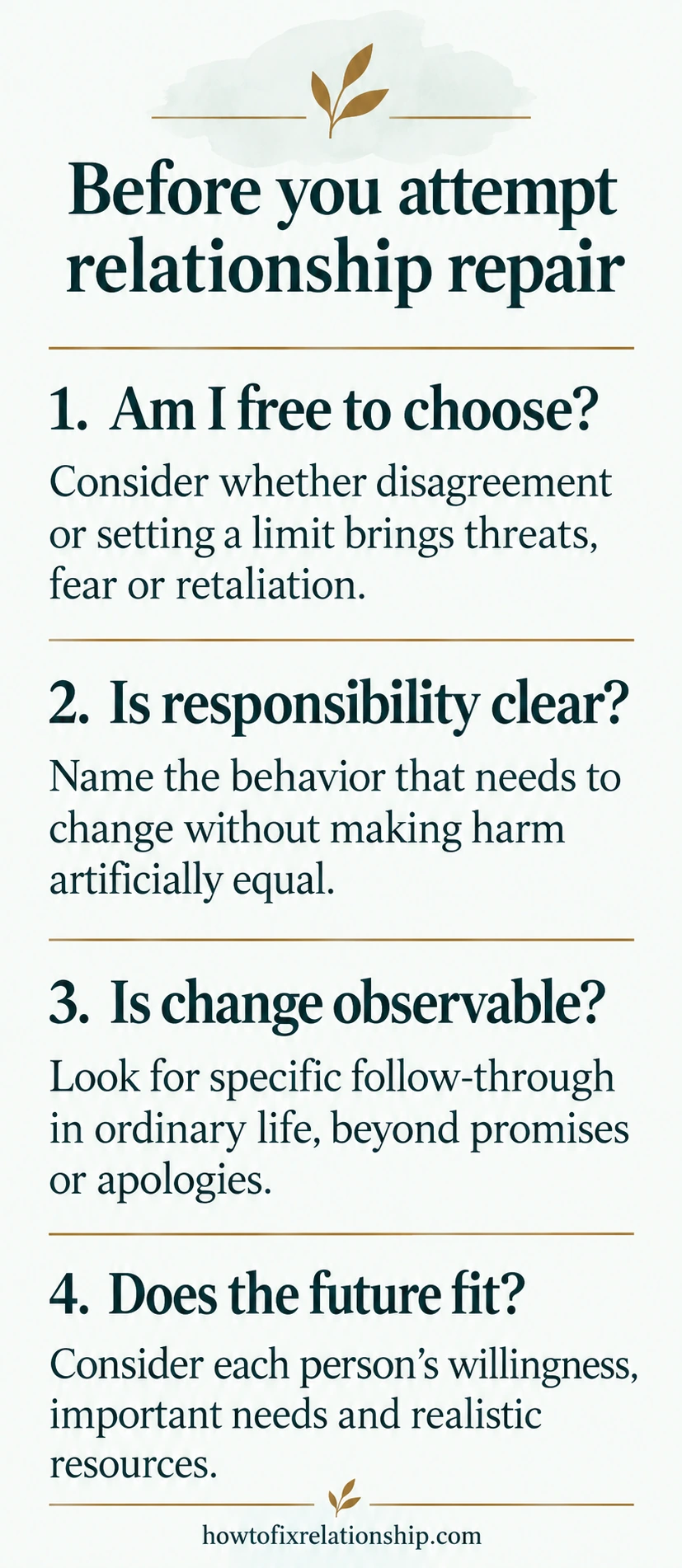
Four questions before attempting repair
Read the guide as text
- Am I free to choose? Consider whether disagreement or setting a limit brings threats, fear or retaliation.
- Is responsibility clear? Name the behavior that needs to change without making harm artificially equal.
- Is change observable? Look for specific follow-through in ordinary life, beyond promises or apologies.
- Does the future fit? Consider each person’s willingness, important needs and realistic resources.
Start with safety and freedom to choose
Can you disagree, set a limit or consider leaving without threats or retaliation? Violence, stalking, sexual pressure and intimidation change the question. You do not have to complete a repair exercise before seeking help or getting safer.
Affectionate moments do not cancel harmful behavior. Consider private specialist support when speaking openly could put you at risk, and use local emergency help for immediate danger.
Describe what is happening in ordinary life
“We have lost our connection” names a feeling, but it may not identify a workable change. Write down what happens: conversations end without an answer, plans are repeatedly cancelled, or shared money is spent without an agreed discussion.
Separate the observation, its effect and your interpretation. “Our plans changed three times without notice, and I could not arrange childcare” gives you more to discuss than “You never cared.” You can still take the pattern seriously without pretending to know the other person’s motives.
Make responsibility specific
Look for acknowledgment of what happened and who needs to act differently. An explanation can provide context; it should not erase responsibility or require you to excuse the behavior.
Shared relationship difficulties do not make every harmful act equally both people’s fault. You can examine your own actions while refusing responsibility for another person’s threats, dishonesty or intimidation.
Check whether both people are participating
Notice who raises concerns, makes arrangements and follows through. Willingness can look different across people: someone may struggle to find words but still listen, keep an appointment and take an agreed task seriously.
Ask each other, “What are you willing to do differently?” Look for an answer that can be recognized in everyday life. One person cannot supply the other person’s interest or consent to continue the relationship.
Look for change outside the conversation
A moving apology or an enjoyable weekend can matter, but neither shows by itself that a recurring problem has changed. Look for ordinary follow-through: a kept commitment, an honest update or a task completed without repeated reminders.

Avoid secret tests, manufactured jealousy and constant surveillance. Clear agreements and real interactions provide information. If a promise is kept only when you threaten to leave, include that pattern in your assessment.
Make disagreement possible without humiliation
Repair does not mean never feeling angry. It does mean being able to raise a concern without threats, ridicule or punishment. Notice whether both people can speak, pause and return to an issue.
The pause-and-return guide offers wording for ordinary disagreements. Communication exercises do not resolve coercive control or make it safe to disclose concerns to someone who retaliates.
Distinguish preferences from essential future choices
Different hobbies or routines may leave room for compromise and separate interests. Decisions about children, relationship structure or where to live may involve needs neither person can comfortably give up.
List what you need, what you can negotiate and what you are still exploring. Discuss whether a future acceptable to both people exists. Affection does not require either person to promise a life they do not want.
Fit the plan to your actual resources
Work, disability, health, money and care responsibilities affect what is realistic. Distinguish an obstacle from unwillingness by looking at whether both people help find an alternative.
For an illustrative example, imagine Lauren and Michael cannot afford the weekly counseling appointments they considered. They explore lower-cost options and agree to work on one household responsibility while reviewing how it goes. That is different from one person expecting the other to find and carry every solution.
A smaller workable step can be useful. Practical limits still deserve an honest discussion when they repeatedly leave an important need unmet.
Agree on an observable action
Choose one pattern and describe what would be different. For example: “Before either of us commits our shared weekend time, we will check the calendar together.” Name who handles the action, how changes will be communicated and when you will review it.
A review point creates an opportunity to learn; it does not oblige you to remain until that date. Serious harm, a breached boundary or a change in what you want can call for an earlier decision.
Review both the result and the way it happened
Ask what changed, whether the practical problem improved and how the process felt. A task can be completed while the disrespect continues—for example, dishes are washed but you are insulted for raising the issue.
Allow for ordinary mistakes that someone acknowledges and corrects. Assess the pattern and the response to a problem, rather than demanding perfection or treating one good day as proof that everything is resolved.
Choose support that fits the situation
When participation is safe and voluntary, a qualified couples therapist may help you explore repeated patterns and choices. Ask about relevant experience, privacy and safety procedures. Individual support is also an option if you want space to clarify your needs.
The Hotline advises against couples counseling in abusive relationships. Seek private specialist guidance instead of relying on joint sessions to stop abuse. No professional or program can guarantee that a particular relationship will continue.
Use the checklist without turning it into a score
Several positive answers do not cancel one serious safety concern. Nor do you need a particular number of problems to decide that a relationship is not right for you.
Use your notes to identify what needs attention, what remains uncertain and what support would help. The checklist can organize your observations; it cannot predict someone’s future behavior or make your decision for you.
Choose one next step that remains yours
You might request a specific change, seek individual support, take time to think or begin planning a separation. Consider what is safe and practical in your situation.
If you choose a repair period, name the change you want to observe and a time to reconsider it. You can acknowledge effort and still decide the relationship does not meet your needs. Your willingness to continue matters alongside your partner’s.
Prepare a concrete repair conversation
Choose one recurring concern for questions about responsibility, observable change and your own choices.
These questions do not predict whether a relationship can be repaired. Fear, coercion or retaliation calls for private specialist support.
Use the questions and examples in the article above; the draft builder needs JavaScript.
15 questions readers ask
1. Can a checklist tell me whether to stay?
No. It can help organise observations and questions, but it cannot decide for you or predict your partner’s future behavior.
2. What should come before communication exercises?
Consider safety and freedom to disagree. Threats, coercion or fear of retaliation call for private specialist support, rather than relying on a shared exercise.
3. How do I describe the problem clearly?
Name an observable pattern and its effect. “Plans changed without notice three times” gives you something more specific to discuss than a conclusion about whether someone cares.
4. Does repair require equal blame?
No. Each person can examine their actions without making responsibility for a particular harmful act equal. Accountability should be accurate.
5. Is an apology evidence of change?
It can begin a conversation. Look for acknowledgment, practical correction and sustained follow-through; an apology alone does not establish that the pattern has changed.
6. What if only one of us wants to work on it?
One person can change their own actions and seek support, but cannot provide the other person’s willingness. Notice who actually participates in agreed steps.
7. How specific should a repair agreement be?
Identify the action, who owns it and when you will review it. An agreement should be recognisable in everyday life without requiring constant surveillance.
8. How long should a trial period last?
There is no universal period that proves repair. Choose a workable review point if safe, while retaining the right to respond to serious harm or changed needs sooner.
9. Should I test my partner secretly?
Avoid traps, manufactured jealousy or hidden tests. Use real interactions and clear agreements as information about how the relationship works.
10. Does a practical obstacle mean someone is unwilling?
Not necessarily. Work, disability, care responsibilities and cost can affect a plan. Look at whether the person helps find a realistic alternative.
11. Can love resolve incompatible life goals?
Affection does not automatically reconcile different wishes about children, relationship structure or where to live. Discuss whether an acceptable future exists for both people.
12. Can disagreement be part of a repair process?
Yes, where both people can participate safely and keep their dignity. A pause should have a workable route back to the issue, rather than endlessly avoiding it.
13. When might professional support help?
A qualified professional may help clarify repeated patterns, needs or decisions. Ask about experience, privacy and safety procedures. Joint counseling is not recommended with an abusive partner.
14. Can things improve and still be insufficient for me?
Yes. Improvement and compatibility are different questions. You can acknowledge genuine change while deciding what you want from the relationship.
15. Do I need my partner to agree before seeking support?
No. You can privately explore your experience and options. If privacy or contact could put you at risk, use a safer channel and specialist safety guidance.