

When an argument turns into repetition, interruptions or a contest over who is right, a pause can protect the conversation. The useful skill is not only stopping; it is making a realistic plan to return.
For ordinary disagreements, name the issue, ask for space and agree when to try again. If someone blocks your exit, threatens you or makes stopping dangerous, prioritize safety and specialist support rather than negotiating the perfect pause.
A pause with a reliable return
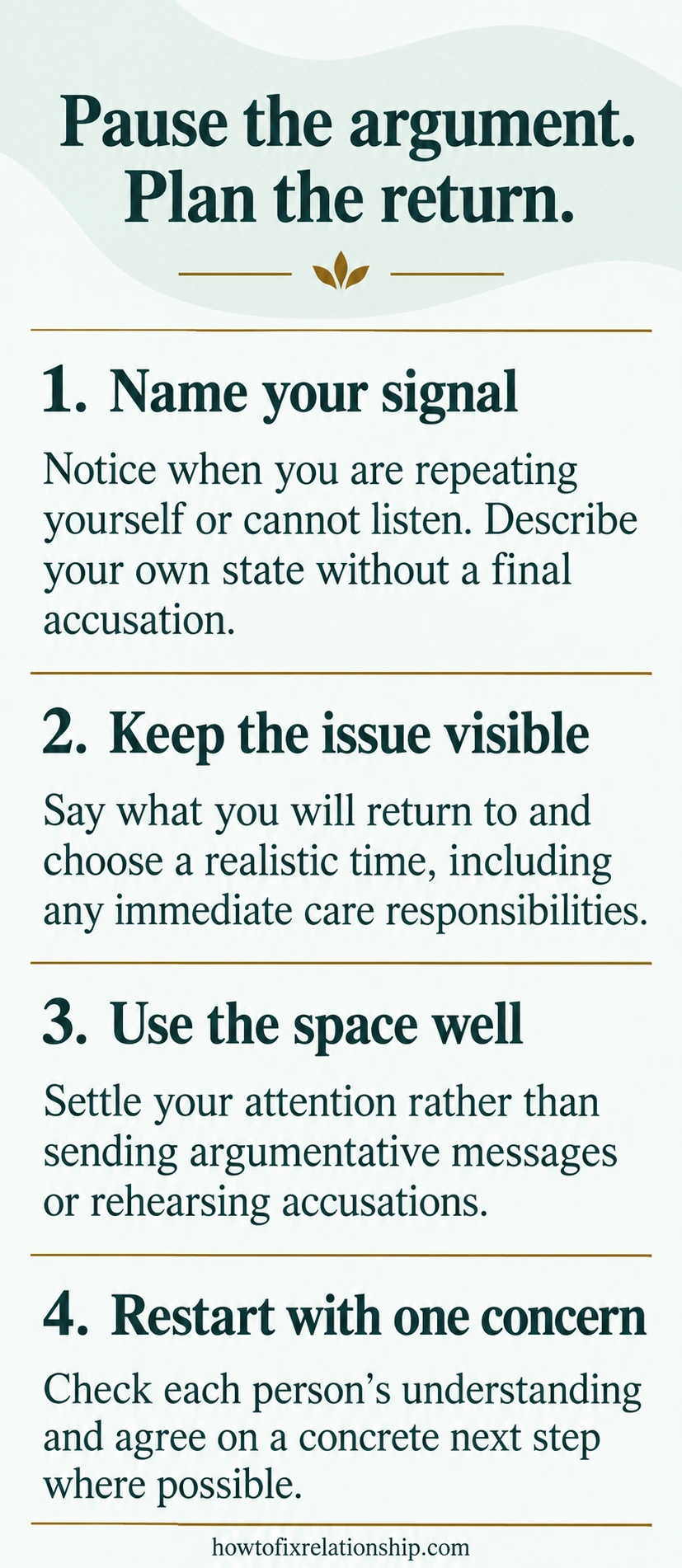
Read the guide as text
- Name your signal. Notice when you are repeating yourself or cannot listen. Describe your own state without a final accusation.
- Keep the issue visible. Say what you will return to and choose a realistic time, including any immediate care responsibilities.
- Use the space well. Settle your attention rather than sending argumentative messages or rehearsing accusations.
- Restart with one concern. Check each person’s understanding and agree on a concrete next step where possible.
Look for Warning Signs
Pay attention to your own signs instead of monitoring your partner for proof that they're being unreasonable. You might talk faster, feel hot, lose track of the question, or prepare an argument while the other person is still talking.
You might decide to go quietly because you can't organize your response fast enough. Silence can reflect many things, so don't assume that if your partner is quiet, they're just withholding. Pick one or two signs you're able to recognize, such as "I keep repeating myself and can't get to the point." This is a useful sign that the conversation needs a change right away.
Mayo Clinic offers practical anger-management guidance, including taking time to think and expressing concerns more clearly once calm. A pause can support that aim without requiring either person to pretend they are no longer upset.
Talk About Taking Breaks Before an Argument Happens
When you and your partner are getting along, and things are calm, it might be a good time to talk about how you'll handle disagreements in the future. Sometimes taking a short break during an argument can help both people calm down and think more clearly. But it's important to understand what taking a break means so neither person feels like the other is avoiding the problem.
Try agreeing on a simple phrase you can use when things start feeling overwhelming, such as, "I need to take a break for a little while." Keep it respectful and avoid using words that make your partner feel like they're being blamed or acting irrationally. The purpose is to let them know that you need some time to calm down, not to make them feel like they're responsible for everything that's happening.
It's also helpful to talk about what will happen during these breaks. Maybe you'll spend some time in separate rooms, take a short walk, or do something that helps you relax. If you have children or other responsibilities, think about how those needs will still be handled. You should also discuss how you'll decide when to return to the conversation.
Remember that you don't need your partner's permission to walk away from a situation where you feel unsafe. But during ordinary disagreements, having a plan you both understand can prevent unnecessary misunderstandings. Your partner might not love the idea of stopping a conversation before it's finished but knowing that you'll return to the issue can make the break feel less like rejection.
Ask for a Break Without Making Things Worse
When an argument starts getting heated, the way you ask for a break can make a difference. Instead of simply walking away or saying something hurtful, try explaining how you're feeling, what you need, and when you'd like to continue the conversation.
For example, you might say, "I'm getting too upset to have a good conversation right now. I need a little time to calm down. Can we finish talking about our budget around seven tonight?" This lets your partner know that you're not ignoring the issue. You just want to discuss it when you're able to listen and respond more calmly.
But saying something like, "I'm done with you," can make your partner think you're threatening to end the relationship instead of asking for a break from the argument. That's why it's important to be clear about what you actually mean.
Of course, you won't always say everything perfectly when you're upset. If you realize that your words came out harsher than you intended, it's okay to explain yourself. You might say, "I didn't mean for that to sound so hurtful. I just want us to stop arguing for a little while, but I do want to work through this."
Try not to use your request for a break as an opportunity to make one last accusation, either. Saying something like, "I need a break because you never listen to me," can keep the argument going instead of helping things settle down.
The important thing is focusing on what you need in that situation and making it clear that you're willing to return to the conversation when you're both ready.
Pick a Time That Works for Both of You
When you decide to take a break during a disagreement, it's important to think about when you'll actually have time to continue talking. Sometimes a short break is enough to help both people calm down, while other situations might need more time.
Your work schedules, family responsibilities, sleep, and the seriousness of the disagreement can all affect when it makes sense to return to the conversation. There's no specific amount of time that works for every couple, so try finding something that feels realistic for both of you.

Instead of saying, "We'll talk about it later," try being a little more specific. You might say, "Can we finish this conversation after dinner?" or "I'd like to talk about this tomorrow evening when we're not so tired." This gives both people a better understanding of what to expect.
If you aren't able to work through the entire issue that day, you can still acknowledge that it needs attention. For example, you might say, "We can agree on what needs to happen tonight, and then tomorrow after dinner we can talk about the bigger decisions."
But make sure the time you suggest actually works for both people. Planning a serious conversation when your partner is working, exhausted, or dealing with something important probably won't lead to a productive discussion.
The goal isn't to pick a time just so you can say you offered to talk. It's about finding an opportunity when both people can give the conversation their attention and feel comfortable expressing their thoughts.
Taking a break should help you communicate better, not become another reason to argue. When both people know that the conversation will be revisited, it can be easier to step away for a little while without feeling like the problem is being ignored.
Keep Responsibilities
A break doesn’t mean that childcare, a stove, transport, or other responsibilities disappear. When safe, find out who's handling what's going on before moving apart. You might say to them, "I'm going to finish getting the children ready. Can we not talk about the budget until they go to sleep?" Don't leave a child responsible for checking in on an adult or persuading the parents to keep talking.
If responsibilities stop a break, then plan a conversation at another time instead of thinking the issue has to be solved when everyone is tired or overloaded. Write down a short note about the topic so you can remember that you need to talk about it later. It should list the issue and not be a list of accusations that you gathered while you waited for the conversation.
Use a Pause to Reduce the Intensity
Pick something that helps you to settle down, such as taking a quiet walk, drinking some water, or slow breathing. The purpose is to make sure that you have enough attention to listen and to think.
Don't use the time to write longer lists of what your partner did wrong. Rehearsing the argument or posting about it online can keep the problem active.
You can get support without asking someone to decide who's right in one situation. You can say something like, "I need help to calm down so I can go back to the hard conversation."
Don't use alcohol or other substances as a plan to be ready to negotiate. If you're not able to at the time, talk about that and give a realistic alternative when you feel better. A break should create capacity, not be an obstacle to a good conversation.
Write Down Clear Points
Write down the event, its effect, and the request you want to talk about. Keep the description specific so that both people can know what the issue is. You might say something like, "The weekend plan changed without me knowing it. I bought food for the guests who didn't get to come. We need to confirm changes before we go shopping." This is easier to talk about than saying something like, "You don't respect anything I do."
Write down a question about the other person's own experiences. You can say something like, "What made it hard for you to update me?" This allows them to have room to answer.
You don't have to ignore your own concerns to be curious. Both can work together. Preparation should make the concern clearer while leaving room for a response or a different understanding.
Make it Understandable Before Looking for Solutions.
Start by naming the situation and a time period. You can say something like, "I'm ready to talk about Sunday's change of plans. We have 20 minutes, but can we first make sure that we understand what each other wants?"
Take turns talking about the issue without interrupting each other. Reflect on what you hear before you defend your own situation. You can say something like, "You thought the change was clear. I understood that the original plan was still in place."
Love is respect provides guidance on healthy relationship boundaries. Respectful disagreement includes room for different views and boundaries, rather than pressure to agree with one person's account.
Understanding isn't the same as agreeing that their behavior was acceptable. You can see what your partner meant but still explain how it affected you. The next question is what each person can do differently, not trying to erase what the other person experienced.
Focus on One Problem When You Start Talking Again
Sometimes an argument that starts over something small can quickly turn into a conversation about everything that's ever gone wrong in the relationship. Maybe you started arguing about an unanswered text message, but before long, you're talking about money, family problems, household responsibilities, and disagreements from months ago. Taking a break won't help much if you come back together and immediately start arguing about everything all over again.
When you're ready to continue the conversation, try focusing on the problem that started the disagreement or whatever issue needs the most attention. If other concerns come up, you can always write them down or agree to discuss them another time. This doesn't mean those problems aren't important. It simply gives you a chance to work through one thing without becoming overwhelmed by everything else.
You might say something like, "I know that's something we need to talk about, too, but I'd really like us to finish discussing this first. We can make time for the other issue afterward." This shows your partner that you're not ignoring their concerns while still keeping the conversation focused.
But remember that focusing on one problem doesn't mean you have to ignore things that are directly connected to it. Sometimes a disagreement is part of a pattern that's been happening for a while and understanding that pattern can help you figure out why the current situation is so upsetting.
The important thing is knowing the difference between discussing related problems and bringing up every past disappointment. When you stay focused on what's actually happening, it's easier to understand each other's feelings and find a practical way to move forward.
Finishing the Conversation with a Plan
Not every disagreement is going to end with both people completely agreeing or feeling better right away. Sometimes the most helpful thing you can do is come up with a small change that addresses the problem and gives you something to work on together.
Instead of ending a conversation with something general like, "You need to be more considerate," try agreeing on something specific. For example, you might decide, "From now on, we'll confirm how many people are coming over before we buy groceries or start preparing food." This gives both people a clear understanding of what needs to happen.
It's also important to talk about who's responsible for doing what and when it needs to be done. If you're both involved in making the change, make sure each person understands their part. You don't want to leave the conversation thinking you've reached an agreement only to discover that one person is still expected to handle everything.
But sometimes you might not be able to agree on a solution, and that's okay, too. If that happens, try identifying what's still bothering you and whether you need more information, time, or outside support. If you regularly struggle to work through disagreements, a qualified couples therapist might be able to help when counseling is appropriate, and both people feel safe participating.
Remember that finishing a difficult conversation doesn't mean you have to apologize before you're ready, offer physical affection, or pretend that everything is suddenly fine. You might still feel hurt, frustrated, or need a little time to process what happened.
The goal is to leave the conversation with a better understanding of the problem and, when possible, a plan for handling it differently. Making progress in a relationship doesn't always mean resolving every feeling right away. Sometimes it simply means agreeing on one positive change and giving each other time to see whether it helps.
Creating a Reliable Return
For an illustrative example, imagine that Leila and Owen disagree about weekend family visits. Leila notices she is interrupting and asks to pause until after dinner. She says what the topic is about so Owen knows it isn’t being ignored.
During the break, both of them handle an agreed task and don't send each other argumentative messages. When they decide to return to it, they talk about one upcoming visit instead of every family disagreement.
They find that Leila needs more notice, and Owen wants more flexibility for the relatives traveling through their area. They agree that if an invitation to their home is extended, both of them should check with each other first.
Even though the pause didn't create identical preferences, it made the conversation about the preferences possible. This result is a good agreement and a reliable return, not proof that one partner was being unreasonable or that conflicts in the future are solved.
Do not let a pause become repeated avoidance
If you keep calling for a break but don't go back to the situation, it can leave hard issues unresolved. Rescheduling each discussion until the other person gives up isn't going to help.
Look at the pattern. Does the person come back when they're able to, and do they acknowledge their concern? Can the timing be changed fairly? You can say to them, “I support us taking breaks, but I need to be able to come back and discuss this. What kind of process can we follow so we don’t keep putting it off?”
If one person chooses to disappear, use silence or access to resources to punish the other, the concern might go beyond avoidance. Get the support you need when needed. A communication plan shouldn't be another person's system where one person decides when the other's needs are allowed to be there.
Put Safety First
If someone follows you from room to room, blocks the doorway, or takes your phone, don't focus on a model you need to do correctly. Instead, put getting safe and appropriate help first.
A domestic abuse advocate can help you come up with a personalized plan. You don't have to negotiate a return time with someone who makes stopping the conversation feel dangerous. For regular conflicts, look at the method when you're calm, such as: Did the signal help, was the return realistic, and did the restart look at the issue?
A good pause will protect both attention and accountability. It gives you time to calm down without losing sight of the concern. Start with an easy sentence, a realistic return, and an issue you can understand together. The goal is to talk about how you can move forward without making the other person lose their voice.
Draft a pause-and-return message
Choose why a pause would help. Add an achievable return plan when you adapt the draft.
A return agreement does not require staying in a threatening situation. If you fear retaliation or cannot pause safely, seek private support.
Use the questions and examples in the article above; the draft builder needs JavaScript.
15 questions readers ask
1. When is it useful to pause an argument?
Consider a pause when repetition, interruptions or rising intensity make listening difficult. You do not need to wait until the exchange is out of control.
2. How can I ask without blaming my partner?
Describe your state and the issue you want to return to. For example, say you are too upset to listen well and propose a time to discuss the budget.
3. Do I need permission to leave an unsafe situation?
No. If stopping or leaving is dangerous, prioritize getting safer and appropriate help rather than negotiating a return time.
4. How long should the break last?
There is no universal duration. Choose enough space to settle and a realistic return time around responsibilities and capacity.
5. What if we cannot finish the discussion today?
Agree on any immediate practical need and a later time for the larger issue. Acknowledging the concern helps keep it from disappearing.
6. Should we agree on a signal in advance?
That can help in an ordinary safe relationship. Discuss the phrase, what a pause means and how you will return while things are calm.
7. What happens to childcare during a pause?
Responsibilities still need attention. When safe, clarify who handles immediate care and never ask a child to mediate or monitor an adult.
8. What should I do during the break?
Choose something that helps you settle, such as water, quiet or a walk. Avoid using the time to build a longer prosecution of your partner.
9. Can we keep texting the argument?
That usually continues the exchange you intended to pause. Agree on necessary practical contact while leaving the disputed issue for the restart.
10. How do we restart?
Name one topic, allow each person to explain and check what you understood before looking for solutions.
11. Do we need to agree about every detail?
No. You can acknowledge different understandings and still make a clear future agreement. Understanding does not require accepting harmful behavior.
12. What makes a useful next step?
Name an action, who will handle it and when. A specific plan is easier to review than a promise to be more considerate.
13. What if my partner repeatedly postpones the return?
Discuss the pattern and its effect. A pause that indefinitely silences concerns may require different support or decisions.
14. What if they follow me or block the door?
Treat that as a safety concern. A communication technique cannot resolve coercion; seek appropriate specialist or emergency help.
15. Can we finish while still feeling upset?
Yes. Progress does not require forced affection, immediate forgiveness or pretending all feelings are resolved. Leave room for further care and reflection.